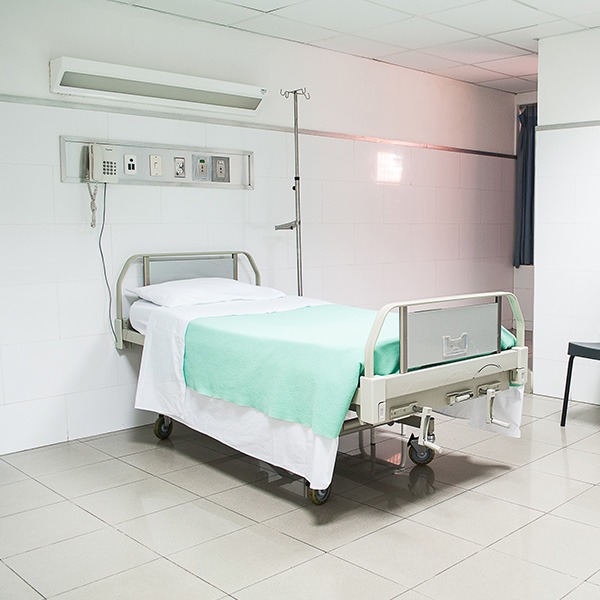
Large hospitals usually have many departments. In order to help patients find their way, many road signs, digital front desks and other tools are distributed in the hospital to help navigate. However, data shows that in some larger hospitals, 1/4 of hospital employees have been lost. There are also reports that 40% to 50% of patients get lost when visiting a hospital they have not visited before for the first time.
In order to solve this problem, some hospitals have begun to adopt VR and AR navigation solutions. The VR navigation method is simple and direct, and does not require 3D space modeling. It only needs to use panoramic cameras and software such as PTGui to create a 360-degree panoramic view. 360° maps are usually integrated into the hospital website and also supported for viewing in VR. Patients can learn about the hospital structure, parking lot location or surrounding accommodation and catering facilities in advance before going to the hospital. The advantage is to give patients the feeling of being in person., and it looks more intuitive than ordinary flat maps. According to statistical reports, VR maps can also improve memory retention and improve the overall navigation experience.
On the other hand, AR navigation can be used as an assistive tool to help patients who have arrived at the hospital navigate. Its feature is that AR navigation signs and route information can be superimposed in the real environment, and patients only need to use their mobile phones to view it. The advantages are that it is convenient and intuitive, and it is faster to find the way.
Usually indoor navigation is based on GPS signals, and due to the blocking of signals by walls, the positioning effect is not accurate enough. Nowadays, AR indoor navigation can use computer vision, allowing you to identify your location through your mobile phone camera. In some cases, AR markers or signal towers will be laid out indoors. For example, Gatwick Airport in the UK once used 2000 battery-powered signals. The tower provides positioning signals for AR navigation.
At present, very few institutions have officially used AR navigation, but hospitals and other scenarios will begin to test this technology. For example, the Rochester Regional Hospital in the United States used AR to navigate doctors and patients. At the end of last year, Qingting. com reported that at the end of last year, a domestic city A hospital provides patients with AR intelligent navigation services that can be activated by scanning a QR code. Registration, payment, pharmacy, clinic, ward and even toilet can be found through this function.
In short, AR navigation has a great application prospect. It can not only navigate hospitals, but also be used in shopping malls, airports and other scenarios. In addition, AR can also be used in marketing, such as scanning the AR logo to pop up offers and providing a window to directly purchase products.


 苏公网安备 32010602011216号